MoreExam
1. Question Content...
EXPLANATION
Answer: X - EXPLANATION Content.
Question1: You need to optimize batch file transfers into Cloud Storage for Mountkirk Games' new Google Cloud solution.The batch files contain game statistics that need to be staged in Cloud Storage and be processed by an extract transform load (ETL) tool. What should you do?
Question2: You are designing a mobile chat application. You want to ensure people cannot spoof chat messages, by providing a message were sent by a specific user.What should you do?
Question3: Your company is designing its application landscape on Compute Engine. Whenever a zonal outage occurs, the application should be restored in another zone as quickly as possible with the latest application dat a. You need to design the solution to meet this requirement. What should you do?
Question4: Auditors visit your teams every 12 months and ask to review all the Google Cloud Identity and Access Management (Cloud IAM) policy changes in the previous 12 months. You want to streamline and expedite the analysis and audit process.What should you do?
Question5: You are developing a globally scaled frontend for a legacy streaming backend data API. This API expects events in strict chronological order with no repeat data for proper processing.Which products should you deploy to ensure guaranteed-once FIFO (first-in, first-out) delivery of data?
Question6: For this question, refer to the Dress4Win case study.Dress4Win would like to become familiar with deploying applications to the cloud by successfully deploying some applications quickly, as is. They have asked for your recommendation. What should you advise?
Question7: You need to reduce the number of unplanned rollbacks of erroneous production deployments in yourcompany's web hosting platform. Improvement to the QA/Test processes accomplished an 80% reduction.Which additional two approaches can you take to further reduce the rollbacks? Choose 2 answers.
Question8: Your company wants to track whether someone is present in a meeting room reserved for a scheduled meeting. There are 1000 meeting rooms across 5 offices on 3 continents. Each room is equipped with a motion sensor that reports its status every second. The data from the motion detector includes only a sensor ID and several different discrete items of information. Analysts will use this data, together with information about account owners and office locations.Which database type should you use?
Question9: You are developing a globally scaled frontend for a legacy streaming backend data API. This API expects events in strict chronological order with no repeat data for proper processing.Which products should you deploy to ensure guaranteed-once FIFO (first-in, first-out) delivery of data?
Question10: Case Study: 5 - Dress4winCompany OverviewDress4win is a web-based company that helps their users organize and manage their personal wardrobe using a website and mobile application. The company also cultivates an active social network that connects their users with designers and retailers. They monetize their services through advertising, e-commerce, referrals, and a freemium app model. The application has grown from a few servers in the founder's garage to several hundred servers and appliances in a collocated data center. However, the capacity of their infrastructure is now insufficient for the application's rapid growth. Because of this growth and the company's desire to innovate faster.Dress4Win is committing to a full migration to a public cloud.Solution ConceptFor the first phase of their migration to the cloud, Dress4win is moving their development and test environments. They are also building a disaster recovery site, because their current infrastructure is at a single location. They are not sure which components of their architecture they can migrate as is and which components they need to change before migrating them.Existing Technical EnvironmentThe Dress4win application is served out of a single data center location. All servers run Ubuntu LTS v16.04.Databases:MySQL. 1 server for user data, inventory, static data:- MySQL 5.8- 8 core CPUs- 128 GB of RAM- 2x 5 TB HDD (RAID 1)Redis 3 server cluster for metadata, social graph, caching. Each server is:- Redis 3.2- 4 core CPUs- 32GB of RAMCompute:40 Web Application servers providing micro-services based APIs and static content.- Tomcat - Java- Nginx- 4 core CPUs- 32 GB of RAM20 Apache Hadoop/Spark servers:- Data analysis- Real-time trending calculations- 8 core CPUS- 128 GB of RAM- 4x 5 TB HDD (RAID 1)3 RabbitMQ servers for messaging, social notifications, and events:- 8 core CPUs- 32GB of RAMMiscellaneous servers:- Jenkins, monitoring, bastion hosts, security scanners- 8 core CPUs- 32GB of RAMStorage appliances:iSCSI for VM hostsFiber channel SAN - MySQL databases- 1 PB total storage; 400 TB availableNAS - image storage, logs, backups- 100 TB total storage; 35 TB availableBusiness RequirementsBuild a reliable and reproducible environment with scaled parity of production.Improve security by defining and adhering to a set of security and Identity and AccessManagement (IAM) best practices for cloud.Improve business agility and speed of innovation through rapid provisioning of new resources.Analyze and optimize architecture for performance in the cloud.Technical RequirementsEasily create non-production environment in the cloud.Implement an automation framework for provisioning resources in cloud.Implement a continuous deployment process for deploying applications to the on-premisesdatacenter or cloud.Support failover of the production environment to cloud during an emergency.Encrypt data on the wire and at rest.Support multiple private connections between the production data center and cloudenvironment.Executive StatementOur investors are concerned about our ability to scale and contain costs with our current infrastructure. They are also concerned that a competitor could use a public cloud platform to offset their up-front investment and free them to focus on developing better features. Our traffic patterns are highest in the mornings and weekend evenings; during other times, 80% of our capacity is sitting idle.Our capital expenditure is now exceeding our quarterly projections. Migrating to the cloud will likely cause an initial increase in spending, but we expect to fully transition before our next hardware refresh cycle. Our total cost of ownership (TCO) analysis over the next 5 years for a public cloud strategy achieves a cost reduction between 30% and 50% over our current model.For this question, refer to the Dress4Win case study. Considering the given business requirements, how would you automate the deployment of web and transactional data layers?
Question11: Your BigQuery project has several users. For audit purposes, you need to see how many queries each user ran in the last month. What should you do?
Question12: Your customer is receiving reports that their recently updated Google App Engine application is taking approximately 30 seconds to load for some of their users. This behavior was not reported before the update.What strategy should you take?
Question13: You are using Cloud Shell and need to install a custom utility for use in a few weeks. Where can you store the file so it is in the default execution path and persists across sessions?
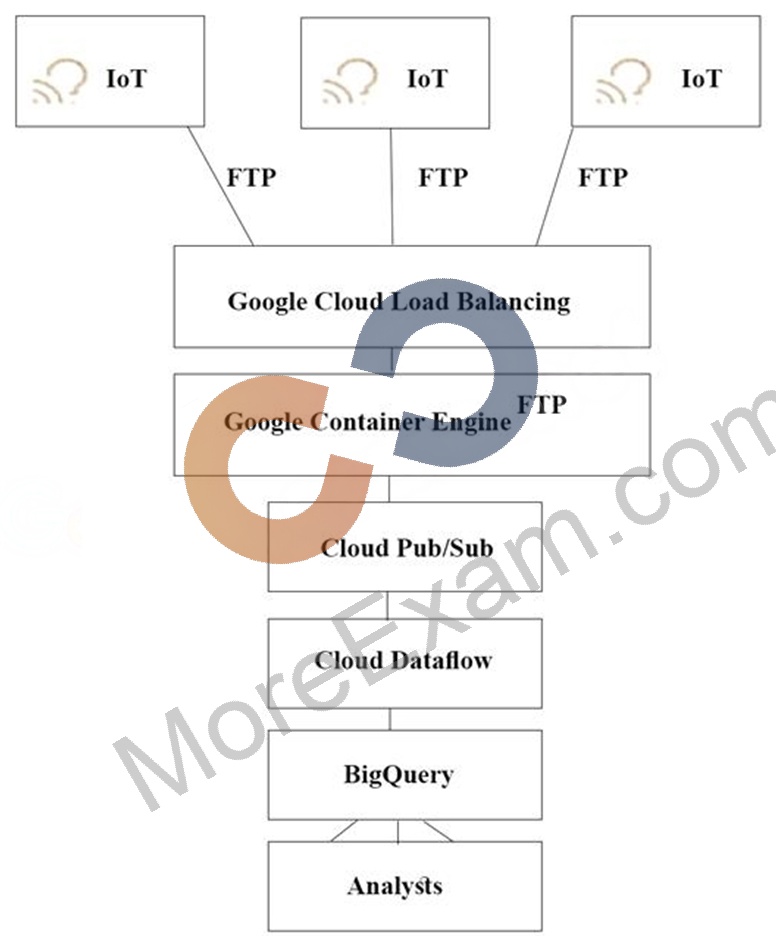
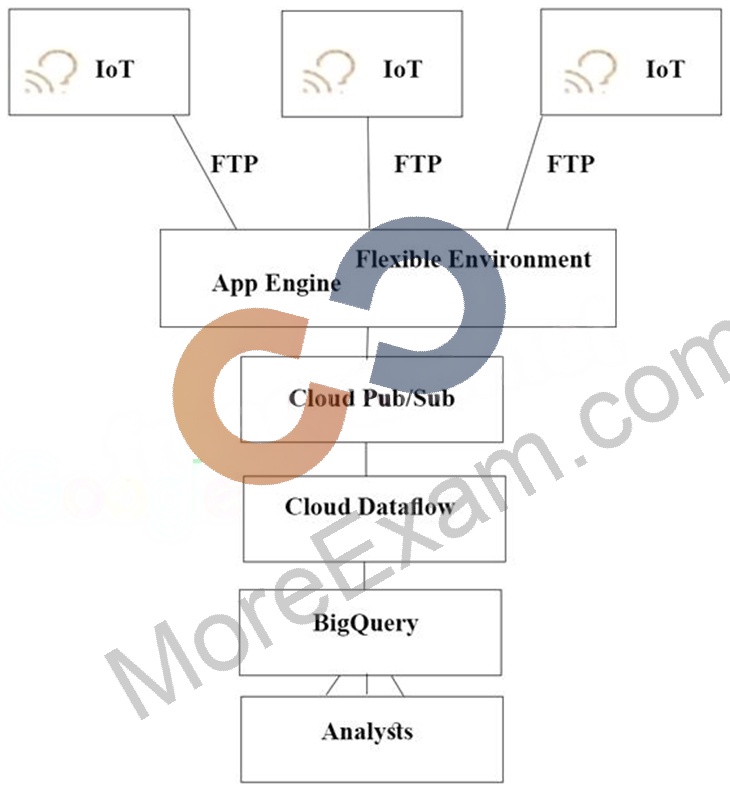
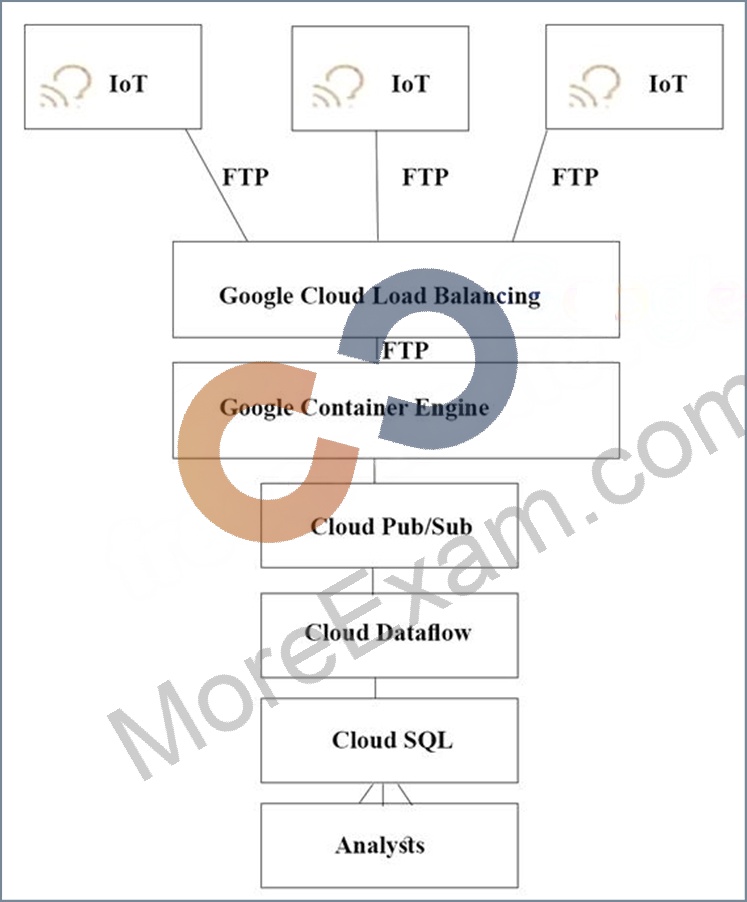
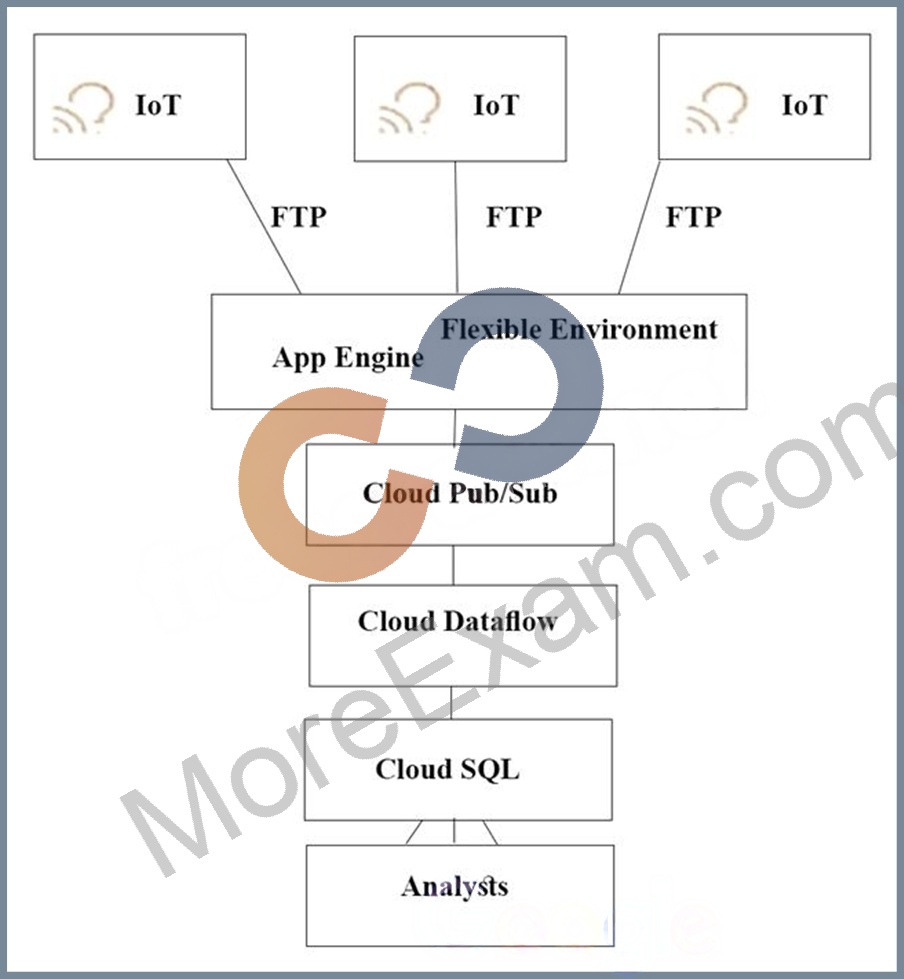
Question14: For this question, refer to the TerramEarth case study.TerramEarth's CTO wants to use the raw data from connected vehicles to help identify approximately when a vehicle in the development team to focus their failure. You want to allow analysts to centrally query the vehicle data. Which architecture should you recommend?
Question15: For this question, refer to the TerramEarth case study.TerramEarth's CTO wants to use the raw data from connected vehicles to help identify approximately when a vehicle in the development team to focus their failure. You want to allow analysts to centrally query the vehicle dat a. Which architecture should you recommend?A)B)C)D)
Question16: Your organization has a 3-tier web application deployed in the same network on Google Cloud Platform. Each tier (web, API, and database) scales independently of the others Network traffic should flow through the web to the API tier and then on to the database tier. Traffic should not flow between the web and the database tier. How should you configure the network?
Question17: Your organization requires that metrics from all applications be retained for 5 years for future analysis in possible legal proceedings.Which approach should you use?
Question18: TerramEarth's 20 million vehicles are scattered around the world. Based on the vehicle's location, its telemetry data is stored in a Google Cloud Storage (GCS) regional bucket (US, Europe, or Asia). The CTO has asked you to run a report on the raw telemetry data to determine why vehicles are breaking down after 100 K miles.You want to run this job on all the data.What is the most cost-effective way to run this job?
Question19: Case Study: 4 - Dress4Win case studyCompany OverviewDress4win is a web-based company that helps their users organize and manage their personal wardrobe using a website and mobile application. The company also cultivates an active social network that connects their users with designers and retailers. They monetize their services through advertising, e-commerce, referrals, and a freemium app model.Company BackgroundDress4win's application has grown from a few servers in the founder's garage to several hundred servers and appliances in a colocated data center. However, the capacity of their infrastructure is now insufficient for the application's rapid growth. Because of this growth and the company's desire to innovate faster, Dress4win is committing to a full migration to a public cloud.Solution ConceptFor the first phase of their migration to the cloud, Dress4win is considering moving their development and test environments. They are also considering building a disaster recovery site, because their current infrastructure is at a single location. They are not sure which components of their architecture they can migrate as is and which components they need to change before migrating them.Existing Technical EnvironmentThe Dress4win application is served out of a single data center location.Databases:MySQL - user data, inventory, static data* Redis - metadata, social graph, caching* Application servers:Tomcat - Java micro-services* Nginx - static content* Apache Beam - Batch processing* Storage appliances:iSCSI for VM hosts* Fiber channel SAN - MySQL databases* NAS - image storage, logs, backups* Apache Hadoop/Spark servers:Data analysis* Real-time trending calculations* MQ servers:Messaging* Social notifications* Events* Miscellaneous servers:Jenkins, monitoring, bastion hosts, security scanners* Business Requirements* Build a reliable and reproducible environment with scaled parity of production. Improve security by defining and adhering to a set of security and Identity and Access Management (IAM) best practices for cloud.Improve business agility and speed of innovation through rapid provisioning of new resources.Analyze and optimize architecture for performance in the cloud. Migrate fully to the cloud if all other requirements are met.Technical RequirementsEvaluate and choose an automation framework for provisioning resources in cloud. Support failover of the production environment to cloud during an emergency. Identify production services that can migrate to cloud to save capacity.Use managed services whenever possible.Encrypt data on the wire and at rest.Support multiple VPN connections between the production data center and cloud environment.CEO StatementOur investors are concerned about our ability to scale and contain costs with our current infrastructure. They are also concerned that a new competitor could use a public cloud platform to offset their up-front investment and freeing them to focus on developing better features.CTO StatementWe have invested heavily in the current infrastructure, but much of the equipment is approaching the end of its useful life. We are consistently waiting weeks for new gear to be racked before we can start new projects. Our traffic patterns are highest in the mornings and weekend evenings; during other times, 80% of our capacity is sitting idle.CFO StatementOur capital expenditure is now exceeding our quarterly projections. Migrating to the cloud will likely cause an initial increase in spending, but we expect to fully transition before our next hardware refresh cycle. Our total cost of ownership (TCO) analysis over the next 5 years puts a cloud strategy between 30 to 50% lower than our current model.For this question, refer to the Dress4Win case study.Dress4Win has configured a new uptime check with Google Stackdriver for several of their legacy services. The Stackdriver dashboard is not reporting the services as healthy. What should they do?
Question20: An application development team believes their current logging tool will not meet their needs for their new cloud-based product. They want a bettor tool to capture errors and help them analyze their historical log dat a. You want to help them find a solution that meets their needs, what should you do?
Question21: For this question, refer to the JencoMart case study.JencoMart has decided to migrate user profile storage to Google Cloud Datastore and the application servers to Google Compute Engine (GCE). During the migration, the existing infrastructure will need access to Datastore to upload the data. What service account key-management strategy should you recommend?
Question22: Your company uses the Firewall Insights feature in the Google Network Intelligence Center. You have several firewall rules applied to Compute Engine instances. You need to evaluate the efficiency of the applied firewall ruleset. When you bring up the Firewall Insights page in the Google Cloud Console, you notice that there are no log rows to display. What should you do to troubleshoot the issue?
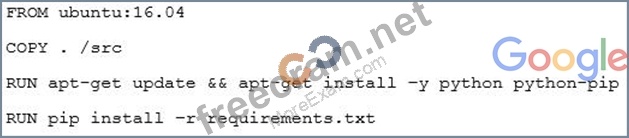
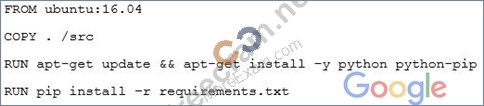
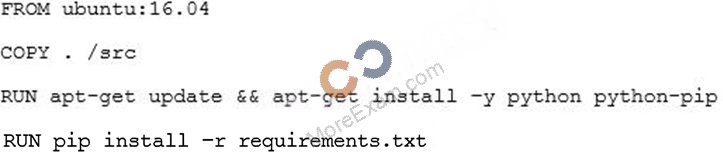
Question23: One of the developers on your team deployed their application In Google Container Engine with the Dockerfile below. They report that their application deployments are taking too long.You want to optimize this Dockerfile for faster deployment times without adversely affecting the app's functionality. Which two actions should you take? Choose 2 answers
Question24: Your web application uses Google Kubernetes Engine to manage several workloads. One workload requires a consistent set of hostnames even after pod scaling and relaunches.Which feature of Kubernetes should you use to accomplish this?
Question25: Your customer wants to do resilience testing of their authentication layer. This consists of a regional managed instance group serving a public REST API that reads from and writes to a Cloud SQL instance.What should you do?
Question26: Your company acquired a healthcare startup and must retain its customers' medical information for up to 4 more years, depending on when it was created. Your corporate policy is to securely retain this data, and then delete it as soon as regulations allow.Which approach should you take?
Question27: Your company plans to migrate a multi-petabyte data set to the cloud. The data set must be available 24hrs a day. Your business analysts have experience only with using a SQL interface.How should you store the data to optimize it for ease of analysis?
Question28: Your application needs to process credit card transactions. You want the smallest scope of Payment Card Industry (PCI) compliance without compromising the ability to analyze transactional data and trends relating to which payment methods are used. How should you design your architecture?
Question29: For this question, refer to the Dress4Win case study.As part of Dress4Win's plans to migrate to the cloud, they want to be able to set up a managed logging and monitoring system so they can handle spikes in their traffic load. They want to ensure that:* The infrastructure can be notified when it needs to scale up and down to handle the ebb and flow of usage throughout the day* Their administrators are notified automatically when their application reports errors.* They can filter their aggregated logs down in order to debug one piece of the application across many hosts Which Google StackDriver features should they use?
Question30: For this question, refer to the Dress4Win case study.As part of their new application experience, Dress4Wm allows customers to upload images of themselves. The customer has exclusive control over who may view these images. Customers should be able to upload images with minimal latency and also be shown their images quickly on the main application page when they log in.Which configuration should Dress4Win use?
Question31: You are tasked with building an online analytical processing (OLAP) marketing analytics and reporting tool. This requires a relational database that can operate on hundreds of terabytes of data. What is the Google- recommended tool for such applications?
Question32: One of your primary business objectives is being able to trust the data stored in your application. You want to log all changes to the application data.How can you design your logging system to verify authenticity of your logs?
Question33: Your development team has created a structured API to retrieve vehicle data. They want to allow third parties to develop tools for dealerships that use this vehicle event data. You want to support delegated authorization against this data.What should you do?
Question34: You are using Cloud Shell and need to install a custom utility for use in a few weeks. Where can you store the file so it is in the default execution path and persists across sessions?
Question35: Your company has an application running on multiple Compute Engine instances. You need to ensure that the application can communicate with an on-premises service that requires high throughput via internal IPs, while minimizing latency. What should you do?
Question36: For this question, refer to the TerramEarth case study.TerramEarth plans to connect all 20 million vehicles in the field to the cloud. This increases the volume to 20 million 600 byte records a second for 40 TB an hour. How should you design the data ingestion?
Question37: Case Study: 6 - TerramEarthCompany OverviewTerramEarth manufactures heavy equipment for the mining and agricultural industries. About80% of their business is from mining and 20% from agriculture. They currently have over 500 dealers and service centers in 100 countries. Their mission is to build products that make their customers more productive.Solution ConceptThere are 20 million TerramEarth vehicles in operation that collect 120 fields of data per second.Data is stored locally on the vehicle and can be accessed for analysis when a vehicle is serviced.The data is downloaded via a maintenance port. This same port can be used to adjust operational parameters, allowing the vehicles to be upgraded in the field with new computing modules.Approximately 200,000 vehicles are connected to a cellular network, allowing TerramEarth to collect data directly. At a rate of 120 fields of data per second with 22 hours of operation per day, TerramEarth collects a total of about 9 TB/day from these connected vehicles.Existing Technical EnvironmentTerramEarth's existing architecture is composed of Linux and Windows-based systems that reside in a single U.S. west coast based data center. These systems gzip CSV files from the field and upload via FTP, and place the data in their data warehouse. Because this process takes time, aggregated reports are based on data that is 3 weeks old.With this data, TerramEarth has been able to preemptively stock replacement parts and reduce unplanned downtime of their vehicles by 60%. However, because the data is stale, some customers are without their vehicles for up to 4 weeks while they wait for replacement parts.Business RequirementsDecrease unplanned vehicle downtime to less than 1 week.* Support the dealer network with more data on how their customers use their equipment to better* position new products and servicesHave the ability to partner with different companies - especially with seed and fertilizer suppliers* in the fast-growing agricultural business - to create compelling joint offerings for their customers.Technical RequirementsExpand beyond a single datacenter to decrease latency to the American Midwest and east* coast.Create a backup strategy.* Increase security of data transfer from equipment to the datacenter.* Improve data in the data warehouse.* Use customer and equipment data to anticipate customer needs.* Application 1: Data ingestA custom Python application reads uploaded datafiles from a single server, writes to the data warehouse.Compute:Windows Server 2008 R2* - 16 CPUs- 128 GB of RAM- 10 TB local HDD storageApplication 2: ReportingAn off the shelf application that business analysts use to run a daily report to see what equipment needs repair. Only 2 analysts of a team of 10 (5 west coast, 5 east coast) can connect to the reporting application at a time.Compute:Off the shelf application. License tied to number of physical CPUs* - Windows Server 2008 R2- 16 CPUs- 32 GB of RAM- 500 GB HDDData warehouse:A single PostgreSQL server* - RedHat Linux- 64 CPUs- 128 GB of RAM- 4x 6TB HDD in RAID 0Executive StatementOur competitive advantage has always been in the manufacturing process, with our ability to build better vehicles for lower cost than our competitors. However, new products with different approaches are constantly being developed, and I'm concerned that we lack the skills to undergo the next wave of transformations in our industry. My goals are to build our skills while addressing immediate market needs through incremental innovations.For this question, refer to the TerramEarth case study. You are asked to design a new architecture for the ingestion of the data of the 200,000 vehicles that are connected to a cellular network. You want to follow Google-recommended practices.Considering the technical requirements, which components should you use for the ingestion of the data?
Question38: One of the developers on your team deployed their application in Google Container Engine with the Dockerfile below. They report that their application deployments are taking too long.You want to optimize this Dockerfile for faster deployment times without adversely affecting the app's functionality.Which two actions should you take? Choose 2 answers.
Question39: You are deploying a PHP App Engine Standard service with SQL as the backend. You want to minimize the number of queries to the database.What should you do?
Question40: Your company has decided to build a backup replica of their on-premises user authentication PostgreSQL database on Google Cloud Platform. The database is 4 TB, and large updates are frequent. Replication requires private address space communication.Which networking approach should you use?
Question41: Your organization wants to control IAM policies for different departments independently, but centrally.Which approach should you take?
Question42: For this question, refer to the Dress4Win case study.Dress4Win has asked you to recommend machine types they should deploy their application servers to. How should you proceed?
Question43: Your customer support tool logs all email and chat conversations to Cloud Bigtable for retention and analysis.What is the recommended approach for sanitizing this data of personally identifiable information or payment card information before initial storage?
Question44: You want to allow your operations learn to store togs from all the production protects in your Organization, without during logs from other projects All of the production projects are contained in a folder. You want to ensure that all logs for existing and new production projects are captured automatically. What should you do?
Question45: Case Study: 5 - Dress4winCompany OverviewDress4win is a web-based company that helps their users organize and manage their personal wardrobe using a website and mobile application. The company also cultivates an active social network that connects their users with designers and retailers. They monetize their services through advertising, e-commerce, referrals, and a freemium app model. The application has grown from a few servers in the founder's garage to several hundred servers and appliances in a collocated data center. However, the capacity of their infrastructure is now insufficient for the application's rapid growth. Because of this growth and the company's desire to innovate faster.Dress4Win is committing to a full migration to a public cloud.Solution ConceptFor the first phase of their migration to the cloud, Dress4win is moving their development and test environments. They are also building a disaster recovery site, because their current infrastructure is at a single location. They are not sure which components of their architecture they can migrate as is and which components they need to change before migrating them.Existing Technical EnvironmentThe Dress4win application is served out of a single data center location. All servers run Ubuntu LTS v16.04.Databases:MySQL. 1 server for user data, inventory, static data:* - MySQL 5.8- 8 core CPUs- 128 GB of RAM- 2x 5 TB HDD (RAID 1)Redis 3 server cluster for metadata, social graph, caching. Each server is:* - Redis 3.2- 4 core CPUs- 32GB of RAMCompute:40 Web Application servers providing micro-services based APIs and static content.* - Tomcat - Java- Nginx- 4 core CPUs- 32 GB of RAM20 Apache Hadoop/Spark servers:* - Data analysis- Real-time trending calculations- 8 core CPUS- 128 GB of RAM- 4x 5 TB HDD (RAID 1)3 RabbitMQ servers for messaging, social notifications, and events:* - 8 core CPUs- 32GB of RAMMiscellaneous servers:* - Jenkins, monitoring, bastion hosts, security scanners- 8 core CPUs- 32GB of RAMStorage appliances:iSCSI for VM hosts* Fiber channel SAN - MySQL databases* - 1 PB total storage; 400 TB availableNAS - image storage, logs, backups* - 100 TB total storage; 35 TB availableBusiness RequirementsBuild a reliable and reproducible environment with scaled parity of production.* Improve security by defining and adhering to a set of security and Identity and Access* Management (IAM) best practices for cloud.Improve business agility and speed of innovation through rapid provisioning of new resources.* Analyze and optimize architecture for performance in the cloud.* Technical RequirementsEasily create non-production environment in the cloud.* Implement an automation framework for provisioning resources in cloud.* Implement a continuous deployment process for deploying applications to the on-premises* datacenter or cloud.Support failover of the production environment to cloud during an emergency.* Encrypt data on the wire and at rest.* Support multiple private connections between the production data center and cloud* environment.Executive StatementOur investors are concerned about our ability to scale and contain costs with our current infrastructure. They are also concerned that a competitor could use a public cloud platform to offset their up-front investment and free them to focus on developing better features. Our traffic patterns are highest in the mornings and weekend evenings; during other times, 80% of our capacity is sitting idle.Our capital expenditure is now exceeding our quarterly projections. Migrating to the cloud will likely cause an initial increase in spending, but we expect to fully transition before our next hardware refresh cycle. Our total cost of ownership (TCO) analysis over the next 5 years for a public cloud strategy achieves a cost reduction between 30% and 50% over our current model.For this question, refer to the Dress4Win case study. You want to ensure that your on-premises architecture meets business requirements before you migrate your solution.What change in the on-premises architecture should you make?
Question46: You set up an autoscaling instance group to serve web traffic for an upcoming launch. After configuring the instance group as a backend service to an HTTP(S) load balancer, you notice that virtual machine (VM) instances are being terminated and re-launched every minute. The instances do not have a public IP address. You have verified the appropriate web response is coming from each instance using the curl command. You want to ensure the backend is configured correctly. What should you do?
Question47: For this question, refer to the Dress4Win case study. Considering the given business requirements, howwould you automate the deployment of web and transactional data layers?
Question48: At Dress4Win, an operations engineer wants to create a tow-cost solution to remotely archive copies ofdatabase backup files.The database files are compressed tar files stored in their current data center.How should he proceed?
Question49: The database administration team has asked you to help them improve the performance of their newdatabase server running on Google Compute Engine. The database is for importing and normalizing theirperformance statistics and is built with MySQL running on Debian Linux. They have an n1-standard-8virtual machine with 80 GB of SSD persistent disk.What should they change to get better performance from this system?
Question50: For this question, refer to the TerramEarth case study. To be compliant with European GDPR regulation, TerramEarth is required to delete data generated from its European customers after a period of 36 months when it contains personal data. In the new architecture, this data will be stored in both Cloud Storage and BigQuery. What should you do?
Question51: You are deploying an application on App Engine that needs to integrate with an on-premises database. For security purposes, your on-premises database must not be accessible through the public Internet. What should you do?
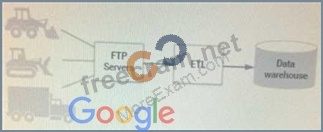
Question52: For this question, refer to the TerramEarth case study.To speed up data retrieval, more vehicles will be upgraded to cellular connections and be able to transmit data to the ETL process. The current FTP process is error-prone and restarts the data transfer from the start of the file when connections fail, which happens often. You want to improve the reliability of the solution and minimize data transfer time on the cellular connections. What should you do?
Question53: For this question, refer to the Mountkirk Games case study. Mountkirk Games wants to design theirsolution for the future in order to take advantage of cloud and technology improvements as they becomeavailable. Which two steps should they take? (Choose two.)
Question54: Your company is designing its data lake on Google Cloud and wants to develop different ingestion pipelines to collect unstructured data from different sources. After the data is stored in Google Cloud, it will be processed in several data pipelines to build a recommendation engine for end users on the website. The structure of the data retrieved from the source systems can change at any time. The data must be stored exactly as it was retrieved for reprocessing purposes in case the data structure is incompatible with the current processing pipelines. You need to design an architecture to support the use case after you retrieve the dat a. What should you do?
Question55: For this question, refer to the Dress4Win case study.Dress4Win has asked you to recommend machine types they should deploy their application servers to.How should you proceed?
Question56: You are implementing the infrastructure for a web service on Google Cloud. The web service needs to receive and store the data from 500,000 requests per second. The data will be queried later in real time, based on exact matches of a known set of attributes. There will be periods where the web service will not receive any requests. The business wants to keep costs low. Which web service platform and database should you use for the application?
Question57: You have deployed several instances on Compute Engine. As a security requirement, instances cannot have a public IP address. There is no VPN connection between Google Cloud and your office, and you need to connect via SSH into a specific machine without violating the security requirements. What should you do?
Question58: Your organization requires that metrics from all applications be retained for 5 years for future analysis in possible legal proceedings. Which approach should you use?
Question59: You need to deploy a stateful workload on Google Cloud. The workload can scale horizontally, but each instance needs to read and write to the same POSIX filesystem. At high load, the stateful workload needs to support up to 100 MB/s of writes. What should you do?
Question60: Your company has a project in Google Cloud with three Virtual Private Clouds (VPCs). There is a Compute Engine instance on each VPC. Network subnets do not overlap and must remain separated. The network configuration is shown below.Instance #1 is an exception and must communicate directly with both Instance #2 and Instance #3 via internal IPs. How should you accomplish this?
Question61: Dress4Win has end-to-end tests covering 100% of their endpoints.They want to ensure that the move to the cloud does not introduce any new bugs.Which additional testing methods should the developers employ to prevent an outage?
Question62: You need to develop procedures to verify resilience of disaster recovery for remote recovery using GCP. Your production environment is hosted on-premises. You need to establish a secure, redundant connection between your on premises network and the GCP network.What should you do?
Question63: For this question, refer to the EHR Healthcare case study. You need to define the technical architecture for securely deploying workloads to Google Cloud. You also need to ensure that only verified containers are deployed using Google Cloud services. What should you do? (Choose two.)
Question64: Your organization wants to control IAM policies for different departments independently, but centrally.Which approach should you take?
Question65: Your company has decided to build a backup replica of their on-premises user authentication PostgreSQL database on Google Cloud Platform. The database is 4 TB, and large updates are frequent. Replication requires private address space communication. Which networking approach should you use?
Question66: You are using a single Cloud SQL instance to serve your application from a specific zone. You want to introduce high availability. What should you do?
Question67: Your development team has created a mobile game app. You want to test the new mobile app on Android and iOS devices with a variety of configurations. You need to ensure that testing is efficient and cost-effective. What should you do?
Question68: Your customer is receiving reports that their recently updated Google App Engine application is taking approximately 30 seconds to load for some of their users. This behavior was not reported before the update. What strategy should you take?
Question69: You have developed an application using Cloud ML Engine that recognizes famous paintings from uploaded images. You want to test the application and allow specific people to upload images for the next 24 hours. Not all users have a Google Account. How should you have users upload images?
Question70: You have an application deployed on Kubernetes Engine using a Deployment named echo-deployment. The deployment is exposed using a Service called echo-service. You need to perform an update to the application with minimal downtime to the application. What should you do?
Question71: Your applications will be writing their logs to BigQuery for analysis. Each application should have its own table.Any logs older than 45 days should be removed. You want to optimize storage and follow Google- recommended practices. What should you do?
Question72: Case Study: 3 - JencoMart Case StudyCompany OverviewJencoMart is a global retailer with over 10,000 stores in 16 countries. The stores carry a range of goods, such as groceries, tires, and jewelry. One of the company's core values is excellent customer service. In addition, they recently introduced an environmental policy to reduce their carbon output by 50% over the next 5 years.Company BackgroundJencoMart started as a general store in 1931, and has grown into one of the world's leading brands known for great value and customer service. Over time, the company transitioned from only physical stores to a stores and online hybrid model, with 25% of sales online. Currently, JencoMart has little presence in Asia, but considers that market key for future growth.Solution ConceptJencoMart wants to migrate several critical applications to the cloud but has not completed a technical review to determine their suitability for the cloud and the engineering required for migration. They currently host all of these applications on infrastructure that is at its end of life and is no longer supported.Existing Technical EnvironmentJencoMart hosts all of its applications in 4 data centers: 3 in North American and 1 in Europe, most applications are dual-homed.JencoMart understands the dependencies and resource usage metrics of their on-premises architecture.Application Customer loyalty portalLAMP (Linux, Apache, MySQL and PHP) application served from the two JencoMart-owned U.S.data centers.Database* Oracle Database stores user profiles* PostgreSQL database stores user credentials-homed in US WestAuthenticates all usersCompute* 30 machines in US West Coast, each machine has:* 20 machines in US East Coast, each machine has:-core CPUStorage* Access to shared 100 TB SAN in each location* Tape backup every weekBusiness Requirements* Optimize for capacity during peak periods and value during off-peak periods* Guarantee service availably and support* Reduce on-premises footprint and associated financial and environmental impact.* Move to outsourcing model to avoid large upfront costs associated with infrastructure purchase* Expand services into Asia.Technical Requirements* Assess key application for cloud suitability.* Modify application for the cloud.* Move applications to a new infrastructure.* Leverage managed services wherever feasible* Sunset 20% of capacity in existing data centers* Decrease latency in AsiaCEO StatementJencoMart will continue to develop personal relationships with our customers as more people access the web. The future of our retail business is in the global market and the connection between online and in-store experiences. As a large global company, we also have a responsibility to the environment through 'green' initiatives and polices.CTO StatementThe challenges of operating data centers prevents focus on key technologies critical to our long- term success. Migrating our data services to a public cloud infrastructure will allow us to focus on big data and machine learning to improve our service customers.CFO StatementSince its founding JencoMart has invested heavily in our data services infrastructure. However, because of changing market trends, we need to outsource our infrastructure to ensure our long- term success. This model will allow us to respond to increasing customer demand during peak and reduce costs.For this question, refer to the JencoMart case study.JencoMart wants to move their User Profiles database to Google Cloud Platform.Which Google Database should they use?
Question73: Case Study: 3 - JencoMart Case StudyCompany OverviewJencoMart is a global retailer with over 10,000 stores in 16 countries. The stores carry a range of goods, such as groceries, tires, and jewelry. One of the company's core values is excellent customer service. In addition, they recently introduced an environmental policy to reduce their carbon output by 50% over the next 5 years.Company BackgroundJencoMart started as a general store in 1931, and has grown into one of the world's leading brands known for great value and customer service. Over time, the company transitioned from only physical stores to a stores and online hybrid model, with 25% of sales online. Currently, JencoMart has little presence in Asia, but considers that market key for future growth.Solution ConceptJencoMart wants to migrate several critical applications to the cloud but has not completed a technical review to determine their suitability for the cloud and the engineering required for migration. They currently host all of these applications on infrastructure that is at its end of life and is no longer supported.Existing Technical EnvironmentJencoMart hosts all of its applications in 4 data centers: 3 in North American and 1 in Europe, most applications are dual-homed.JencoMart understands the dependencies and resource usage metrics of their on-premises architecture.Application Customer loyalty portalLAMP (Linux, Apache, MySQL and PHP) application served from the two JencoMart-owned U.S.data centers.Database* Oracle Database stores user profiles* PostgreSQL database stores user credentials-homed in US WestAuthenticates all usersCompute* 30 machines in US West Coast, each machine has:* 20 machines in US East Coast, each machine has:-core CPURAID 1)Storage* Access to shared 100 TB SAN in each location* Tape backup every weekBusiness Requirements* Optimize for capacity during peak periods and value during off-peak periods* Guarantee service availably and support* Reduce on-premises footprint and associated financial and environmental impact.* Move to outsourcing model to avoid large upfront costs associated with infrastructure purchase* Expand services into Asia.Technical Requirements* Assess key application for cloud suitability.* Modify application for the cloud.* Move applications to a new infrastructure.* Leverage managed services wherever feasible* Sunset 20% of capacity in existing data centers* Decrease latency in AsiaCEO StatementJencoMart will continue to develop personal relationships with our customers as more people access the web. The future of our retail business is in the global market and the connection between online and in-store experiences. As a large global company, we also have a responsibility to the environment through 'green' initiatives and polices.CTO StatementThe challenges of operating data centers prevents focus on key technologies critical to our long- term success. Migrating our data services to a public cloud infrastructure will allow us to focus on big data and machine learning to improve our service customers.CFO StatementSince its founding JencoMart has invested heavily in our data services infrastructure. However, because of changing market trends, we need to outsource our infrastructure to ensure our long- term success. This model will allow us to respond to increasing customer demand during peak and reduce costs.For this question, refer to the JencoMart case study.JencoMart has decided to migrate user profile storage to Google Cloud Datastore and the application servers to Google Compute Engine (GCE). During the migration, the existing infrastructure will need access to Datastore to upload the dat
Question74: An application development team has come to you for advice.They are planning to write and deploy an HTTP(S) API using Go 1.12. The API will have a very unpredictable workload and must remain reliable during peaks in traffic. They want to minimize operational overhead for this application. What approach should you recommend?
Question75: You write a Python script to connect to Google BigQuery from a Google Compute Engine virtual machine. The script is printing errors that it cannot connect to BigQuery. What should you do to fix the script?
Question76: Your organization wants to control IAM policies for different departments independently, but centrally.Which approach should you take?
Question77: An application development team believes their current logging tool will not meet their needs for their new cloud-based product. They want a better tool to capture errors and help them analyze their historical log data. You want to help them find a solution that meets their needs.What should you do?
Question78: Your marketing department wants to send out a promotional email campaign. The development team wants to minimize direct operation management. They project a wide range of possible customer responses, from 100 to 500,000 click-throughs per day. The link leads to a simple website that explains the promotion and collects user information and preferences. Which infrastructure should you recommend?
Question79: Case Study: 6 - TerramEarthCompany OverviewTerramEarth manufactures heavy equipment for the mining and agricultural industries. About80% of their business is from mining and 20% from agriculture. They currently have over 500 dealers and service centers in 100 countries. Their mission is to build products that make their customers more productive.Solution ConceptThere are 20 million TerramEarth vehicles in operation that collect 120 fields of data per second.Data is stored locally on the vehicle and can be accessed for analysis when a vehicle is serviced.The data is downloaded via a maintenance port. This same port can be used to adjust operational parameters, allowing the vehicles to be upgraded in the field with new computing modules.Approximately 200,000 vehicles are connected to a cellular network, allowing TerramEarth to collect data directly. At a rate of 120 fields of data per second with 22 hours of operation per day, TerramEarth collects a total of about 9 TB/day from these connected vehicles.Existing Technical EnvironmentTerramEarth's existing architecture is composed of Linux and Windows-based systems that reside in a single U.S. west coast based data center. These systems gzip CSV files from the field and upload via FTP, and place the data in their data warehouse. Because this process takes time, aggregated reports are based on data that is 3 weeks old.With this data, TerramEarth has been able to preemptively stock replacement parts and reduce unplanned downtime of their vehicles by 60%. However, because the data is stale, some customers are without their vehicles for up to 4 weeks while they wait for replacement parts.Business RequirementsDecrease unplanned vehicle downtime to less than 1 week.Support the dealer network with more data on how their customers use their equipment to betterposition new products and servicesHave the ability to partner with different companies - especially with seed and fertilizer suppliersin the fast-growing agricultural business - to create compelling joint offerings for their customers.Technical RequirementsExpand beyond a single datacenter to decrease latency to the American Midwest and eastcoast.Create a backup strategy.Increase security of data transfer from equipment to the datacenter.Improve data in the data warehouse.Use customer and equipment data to anticipate customer needs.Application 1: Data ingestA custom Python application reads uploaded datafiles from a single server, writes to the data warehouse.Compute:Windows Server 2008 R2- 16 CPUs- 128 GB of RAM- 10 TB local HDD storageApplication 2: ReportingAn off the shelf application that business analysts use to run a daily report to see what equipment needs repair. Only 2 analysts of a team of 10 (5 west coast, 5 east coast) can connect to the reporting application at a time.Compute:Off the shelf application. License tied to number of physical CPUs- Windows Server 2008 R2- 16 CPUs- 32 GB of RAM- 500 GB HDDData warehouse:A single PostgreSQL server- RedHat Linux- 64 CPUs- 128 GB of RAM- 4x 6TB HDD in RAID 0Executive StatementOur competitive advantage has always been in the manufacturing process, with our ability to build better vehicles for lower cost than our competitors. However, new products with different approaches are constantly being developed, and I'm concerned that we lack the skills to undergo the next wave of transformations in our industry. My goals are to build our skills while addressing immediate market needs through incremental innovations.For this question, refer to the TerramEarth case study. You need to implement a reliable, scalable GCP solution for the data warehouse for your company, TerramEarth. Considering the TerramEarth business and technical requirements, what should you do?
Question80: For this question, refer to the Mountkirk Games case study.Mountkirk Games wants to set up a real-time analytics platform for their new game. The new platform must meet their technical requirements. Which combination of Google technologies will meet all of their requirements?
Question81: Your development teams release new versions of games running on Google Kubernetes Engine (GKE) daily.You want to create service level indicators (SLIs) to evaluate the quality of the new versions from the user's perspective. What should you do?
Question82: For this question, refer to the Mountkirk Games case study. You need to analyze and define the technical architecture for the database workloads for your company, Mountkirk Games. Considering the business and technical requirements, what should you do?
Question83: Your company has announced that they will be outsourcing operations functions. You want to allow developers to easily stage new versions of a cloud-based application in the production environment and allow the outsourced operations team to autonomously promote staged versions to production. You want to minimize the operational overhead of the solution. Which Google Cloud product should you migrate to?
Question84: A production database virtual machine on Google Compute Engine has an ext4-formatted persistent disk for data files The database is about to run out of storage space How can you remediate the problem with the least amount of downtime?
Question85: Your company is using BigQuery as its enterprise data warehouse. Data is distributed over several Google Cloud projects. All queries on BigQuery need to be billed on a single project. You want to make sure that no query costs are incurred on the projects that contain the data. Users should be able to query the datasets, but not edit them.How should you configure users' access roles?
Question86: You need to develop procedures to verify resilience of disaster recovery for remote recovery using GCP.Your production environment is hosted on-premises. You need to establish a secure, redundant connection between your on-premises network and the GCP network.What should you do?
Question87: For this question, refer to the TerramEarth case study.The TerramEarth development team wants to create an API to meet the company's business requirements. You want the development team to focus their development effort on business value versus creating a custom framework. Which method should they use?
Question88: Your company is running a stateless application on a Compute Engine instance. The application is used heavily during regular business hours and lightly outside of business hours. Users are reporting that the application is slow during peak hours. You need to optimize the application's performance. What should you do?
Question89: For this question, refer to the TerramEarth case study. To be compliant with European GDPR regulation, TerramEarth is required to delete data generated from its European customers after a period of 36 months when it contains personal data. In the new architecture, this data will be stored in both Cloud Storage and BigQuery. What should you do?
Question90: Your application needs to process credit card transactions. You want the smallest scope of Payment Card Industry (PCI) compliance without compromising the ability to analyze transactional data and trends relating to which payment methods are used.How should you design your architecture?
Question91: For this question, refer to the Helicopter Racing League (HRL) case study. Your team is in charge of creating a payment card data vault for card numbers used to bill tens of thousands of viewers, merchandise consumers, and season ticket holders. You need to implement a custom card tokenization service that meets the following requirements:* It must provide low latency at minimal cost.* It must be able to identify duplicate credit cards and must not store plaintext card numbers.* It should support annual key rotation.Which storage approach should you adopt for your tokenization service?
Question92: Case Study: 3 - JencoMart Case StudyCompany OverviewJencoMart is a global retailer with over 10,000 stores in 16 countries. The stores carry a range of goods, such as groceries, tires, and jewelry. One of the company's core values is excellent customer service. In addition, they recently introduced an environmental policy to reduce their carbon output by 50% over the next 5 years.Company BackgroundJencoMart started as a general store in 1931, and has grown into one of the world's leading brands known for great value and customer service. Over time, the company transitioned from only physical stores to a stores and online hybrid model, with 25% of sales online. Currently, JencoMart has little presence in Asia, but considers that market key for future growth.Solution ConceptJencoMart wants to migrate several critical applications to the cloud but has not completed a technical review to determine their suitability for the cloud and the engineering required for migration. They currently host all of these applications on infrastructure that is at its end of life and is no longer supported.Existing Technical EnvironmentJencoMart hosts all of its applications in 4 data centers: 3 in North American and 1 in Europe, most applications are dual-homed.JencoMart understands the dependencies and resource usage metrics of their on-premises architecture.Application Customer loyalty portalLAMP (Linux, Apache, MySQL and PHP) application served from the two JencoMart-owned U.S.data centers.Database* Oracle Database stores user profiles* PostgreSQL database stores user credentials-homed in US WestAuthenticates all usersCompute* 30 machines in US West Coast, each machine has:* 20 machines in US East Coast, each machine has:-core CPURAID 1)Storage* Access to shared 100 TB SAN in each location* Tape backup every weekBusiness Requirements* Optimize for capacity during peak periods and value during off-peak periods* Guarantee service availably and support* Reduce on-premises footprint and associated financial and environmental impact.* Move to outsourcing model to avoid large upfront costs associated with infrastructure purchase* Expand services into Asia.Technical Requirements* Assess key application for cloud suitability.* Modify application for the cloud.* Move applications to a new infrastructure.* Leverage managed services wherever feasible* Sunset 20% of capacity in existing data centers* Decrease latency in AsiaCEO StatementJencoMart will continue to develop personal relationships with our customers as more people access the web. The future of our retail business is in the global market and the connection between online and in-store experiences. As a large global company, we also have a responsibility to the environment through 'green' initiatives and polices.CTO StatementThe challenges of operating data centers prevents focus on key technologies critical to our long- term success. Migrating our data services to a public cloud infrastructure will allow us to focus on big data and machine learning to improve our service customers.CFO StatementSince its founding JencoMart has invested heavily in our data services infrastructure. However, because of changing market trends, we need to outsource our infrastructure to ensure our long- term success. This model will allow us to respond to increasing customer demand during peak and reduce costs.For this question, refer to the JencoMart case study.JencoMart has built a version of their application on Google Cloud Platform that serves traffic to Asia. You want to measure success against their business and technical goals. Which metrics should you track?
Question93: Case Study: 5 - Dress4winCompany OverviewDress4win is a web-based company that helps their users organize and manage their personal wardrobe using a website and mobile application. The company also cultivates an active social network that connects their users with designers and retailers. They monetize their services through advertising, e-commerce, referrals, and a freemium app model. The application has grown from a few servers in the founder's garage to several hundred servers and appliances in a collocated data center. However, the capacity of their infrastructure is now insufficient for the application's rapid growth. Because of this growth and the company's desire to innovate faster.Dress4Win is committing to a full migration to a public cloud.Solution ConceptFor the first phase of their migration to the cloud, Dress4win is moving their development and test environments. They are also building a disaster recovery site, because their current infrastructure is at a single location. They are not sure which components of their architecture they can migrate as is and which components they need to change before migrating them.Existing Technical EnvironmentThe Dress4win application is served out of a single data center location. All servers run Ubuntu LTS v16.04.Databases:MySQL. 1 server for user data, inventory, static data:* - MySQL 5.8- 8 core CPUs- 128 GB of RAM- 2x 5 TB HDD (RAID 1)Redis 3 server cluster for metadata, social graph, caching. Each server is:* - Redis 3.2- 4 core CPUs- 32GB of RAMCompute:40 Web Application servers providing micro-services based APIs and static content.* - Tomcat - Java- Nginx- 4 core CPUs- 32 GB of RAM20 Apache Hadoop/Spark servers:* - Data analysis- Real-time trending calculations- 8 core CPUS- 128 GB of RAM- 4x 5 TB HDD (RAID 1)3 RabbitMQ servers for messaging, social notifications, and events:* - 8 core CPUs- 32GB of RAMMiscellaneous servers:* - Jenkins, monitoring, bastion hosts, security scanners- 8 core CPUs- 32GB of RAMStorage appliances:iSCSI for VM hosts* Fiber channel SAN - MySQL databases* - 1 PB total storage; 400 TB availableNAS - image storage, logs, backups* - 100 TB total storage; 35 TB availableBusiness RequirementsBuild a reliable and reproducible environment with scaled parity of production.* Improve security by defining and adhering to a set of security and Identity and Access* Management (IAM) best practices for cloud.Improve business agility and speed of innovation through rapid provisioning of new resources.* Analyze and optimize architecture for performance in the cloud.* Technical RequirementsEasily create non-production environment in the cloud.* Implement an automation framework for provisioning resources in cloud.* Implement a continuous deployment process for deploying applications to the on-premises* datacenter or cloud.Support failover of the production environment to cloud during an emergency.* Encrypt data on the wire and at rest.* Support multiple private connections between the production data center and cloud* environment.Executive StatementOur investors are concerned about our ability to scale and contain costs with our current infrastructure. They are also concerned that a competitor could use a public cloud platform to offset their up-front investment and free them to focus on developing better features. Our traffic patterns are highest in the mornings and weekend evenings; during other times, 80% of our capacity is sitting idle.Our capital expenditure is now exceeding our quarterly projections. Migrating to the cloud will likely cause an initial increase in spending, but we expect to fully transition before our next hardware refresh cycle. Our total cost of ownership (TCO) analysis over the next 5 years for a public cloud strategy achieves a cost reduction between 30% and 50% over our current model.For this question, refer to the Dress4Win case study. You are responsible for the security of data stored in Cloud Storage for your company, Dress4Win. You have already created a set of Google Groups and assigned the appropriate users to those groups. You should use Google best practices and implement the simplest design to meet the requirements.Considering Dress4Win's business and technical requirements, what should you do?
Question94: You set up an autoscaling instance group to serve web traffic for an upcoming launch. After configuring the instance group as a backend service to an HTTP(S) load balancer, you notice that virtual machine (VM) instances are being terminated and re-launched every minute. The instances do not have a public IP address.You have verified the appropriate web response is coming from each instance using the curl command. You want to ensure the backend is configured correctly. What should you do?
Question95: For this question, refer to the TerramEarth case study. A new architecture that writes all incoming data to BigQuery has been introduced. You notice that the data is dirty, and want to ensure data quality on an automated daily basis while managing cost.What should you do?
Question96: Dress4Win has end-to-end tests covering 100% of their endpoints.They want to ensure that the move to the cloud does not introduce any new bugs.Which additional testing methods should the developers employ to prevent an outage?
Question97: Your marketing department wants to send out a promotional email campaign. The development team wants to minimize direct operation management. They project a wide range of possible customer responses, from 100 to 500,000 click-throughs per day. The link leads to a simple website that explains the promotion and collects user information and preferences. Which infrastructure should you recommend? (CHOOSE TWO)
Question98: Case Study: 5 - Dress4winCompany OverviewDress4win is a web-based company that helps their users organize and manage their personal wardrobe using a website and mobile application. The company also cultivates an active social network that connects their users with designers and retailers. They monetize their services through advertising, e-commerce, referrals, and a freemium app model. The application has grown from a few servers in the founder's garage to several hundred servers and appliances in a collocated data center. However, the capacity of their infrastructure is now insufficient for the application's rapid growth. Because of this growth and the company's desire to innovate faster.Dress4Win is committing to a full migration to a public cloud.Solution ConceptFor the first phase of their migration to the cloud, Dress4win is moving their development and test environments. They are also building a disaster recovery site, because their current infrastructure is at a single location. They are not sure which components of their architecture they can migrate as is and which components they need to change before migrating them.Existing Technical EnvironmentThe Dress4win application is served out of a single data center location. All servers run Ubuntu LTS v16.04.Databases:MySQL. 1 server for user data, inventory, static data:- MySQL 5.8- 8 core CPUs- 128 GB of RAM- 2x 5 TB HDD (RAID 1)Redis 3 server cluster for metadata, social graph, caching. Each server is:- Redis 3.2- 4 core CPUs- 32GB of RAMCompute:40 Web Application servers providing micro-services based APIs and static content.- Tomcat - Java- Nginx- 4 core CPUs- 32 GB of RAM20 Apache Hadoop/Spark servers:- Data analysis- Real-time trending calculations- 8 core CPUS- 128 GB of RAM- 4x 5 TB HDD (RAID 1)3 RabbitMQ servers for messaging, social notifications, and events:- 8 core CPUs- 32GB of RAMMiscellaneous servers:- Jenkins, monitoring, bastion hosts, security scanners- 8 core CPUs- 32GB of RAMStorage appliances:iSCSI for VM hostsFiber channel SAN - MySQL databases- 1 PB total storage; 400 TB availableNAS - image storage, logs, backups- 100 TB total storage; 35 TB availableBusiness RequirementsBuild a reliable and reproducible environment with scaled parity of production.Improve security by defining and adhering to a set of security and Identity and AccessManagement (IAM) best practices for cloud.Improve business agility and speed of innovation through rapid provisioning of new resources.Analyze and optimize architecture for performance in the cloud.Technical RequirementsEasily create non-production environment in the cloud.Implement an automation framework for provisioning resources in cloud.Implement a continuous deployment process for deploying applications to the on-premisesdatacenter or cloud.Support failover of the production environment to cloud during an emergency.Encrypt data on the wire and at rest.Support multiple private connections between the production data center and cloudenvironment.Executive StatementOur investors are concerned about our ability to scale and contain costs with our current infrastructure. They are also concerned that a competitor could use a public cloud platform to offset their up-front investment and free them to focus on developing better features. Our traffic patterns are highest in the mornings and weekend evenings; during other times, 80% of our capacity is sitting idle.Our capital expenditure is now exceeding our quarterly projections. Migrating to the cloud will likely cause an initial increase in spending, but we expect to fully transition before our next hardware refresh cycle. Our total cost of ownership (TCO) analysis over the next 5 years for a public cloud strategy achieves a cost reduction between 30% and 50% over our current model.For this question, refer to the Dress4Win case study. You are responsible for the security of data stored in Cloud Storage for your company, Dress4Win. You have already created a set of Google Groups and assigned the appropriate users to those groups. You should use Google best practices and implement the simplest design to meet the requirements.Considering Dress4Win's business and technical requirements, what should you do?
Question99: Your company has decided to make a major revision of their API in order to create better experiences for their developers. They need to keep the old version of the API available and deployable, while allowing new customers and testers to try out the new API. They want to keep the same SSL and DNS records in place to serve both APIs. What should they do?
Question100: You are using a single Cloud SQL instance to serve your application from a specific zone. You want to introduce high availability. What should you do?
Question101: Your customer is moving an existing corporate application to Google Cloud Platform from an on-premises data center. The business owners require minimal user disruption. There are strict security team requirements for storing passwords. What authentication strategy should they use?
Question102: Your company and one of its partners each nave a Google Cloud protect in separate organizations. Your company s protect (prj-a) runs in Virtual Private Cloud (vpc-a). The partner's project (prj-b) runs in vpc-b. There are two instances running on vpc-a and one instance running on vpc-b Subnets denned in both VPCs are not overlapping. You need to ensure that all instances communicate with each other via internal IPs minimizing latency and maximizing throughput. What should you do?
Question103: Your company places a high value on being responsive and meeting customer needs quickly. Their primary business objectives are release speed and agility. You want to reduce the chance of security errors being accidentally introduced.Which two actions can you take? (Choose two.)
Question104: For this question, refer to the Helicopter Racing League (HRL) case study. HRL wants better prediction accuracy from their ML prediction models. They want you to use Google's AI Platform so HRL can understand and interpret the predictions. What should you do?
Question105: Your company sends all Google Cloud logs to Cloud Logging. Your security team wants to monitor the logs. You want to ensure that the security team can react quickly if an anomaly such as an unwanted firewall change or server breach is detected. You want to follow Google-recommended practices. What should you do?
Question106: Your BigQuery project has several users. For audit purposes, you need to see how many queries each user ran in the last month. What should you do?
Question107: Mountkirk Games' gaming servers are not automatically scaling properly. Last month, they rolled out a newfeature, which suddenly became very popular. A record number of users are trying to use the service, butmany of them are getting 503 errors and very slow response times. What should they investigate first?
Question108: For this question, refer to the Dress4Win case study. Which of the compute services should be migrated as -is and would still be an optimized architecture for performance in the cloud?
Question109: Your organization has a 3-tier web application deployed in the same network on Google Cloud Platform. Each tier (web, API, and database) scales independently of the others. Network traffic should flow through the web to the API tier and then on to the database tier. Traffic should not flow between the web and the database tier.How should you configure the network?
Question110: Your company is moving 75 TB of data into Google Cloud. You want to use Cloud Storage and follow Googlerecommended practices. What should you do?
Question111: For this question, refer to the Dress4Win case study. You are responsible for the security of data stored in Cloud Storage for your company, Dress4Win. You have already created a set of Google Groups and assigned the appropriate users to those groups. You should use Google best practices and implement the simplest design to meet the requirements.Considering Dress4Win's business and technical requirements, what should you do?
Question112: You are using Cloud SQL as the database backend for a large CRM deployment. You want to scale as usage increases and ensure that you don't run out of storage, maintain 75% CPU usage cores, and keep replication lag below 60 seconds. What are the correct steps to meet your requirements?
Question113: For this question, refer to the Dress4Win case study. To be legally compliant during an audit, Dress4Win must be able to give insights in all administrative actions that modify the configuration or metadata of resources on Google Cloud.What should you do?
Question114: Your company has decided to make a major revision of their API in order to create better experiences for their developers. They need to keep the old version of the API available and deployable, while allowing new customers and testers to try out the new API. They want to keep the same SSL and DNS records in place to serve both APIs. What should they do?
Question115: For this question, refer to the Dress4Win case study.You want to ensure Dress4Win's sales and tax records remain available for infrequent viewing by auditors for at least 10 years. Cost optimization is your top priority. Which cloud services should you choose?
Question116: For this question, refer to the Helicopter Racing League (HRL) case study. A recent finance audit of cloud infrastructure noted an exceptionally high number of Compute Engine instances are allocated to do video encoding and transcoding. You suspect that these Virtual Machines are zombie machines that were not deleted after their workloads completed. You need to quickly get a list of which VM instances are idle. What should you do?
Question117: You are using a single Cloud SQL instance to serve your application from a specific zone. You want to introduce high availability. What should you do?
Question118: A production database virtual machine on Google Compute Engine has an ext4-formatted persistent disk for data files The database is about to run out of storage space How can you remediate the problem with the least amount of downtime?
Question119: Your company has an application running on multiple Compute Engine instances. You need to ensure that the application can communicate with an on-premises service that requires high throughput via internal IPs, while minimizing latency. What should you do?
Question120: For this question, refer to the JencoMart case study.JencoMart has built a version of their application on Google Cloud Platform that serves traffic to Asia.You want to measure success against their business and technical goals. Which metrics should you track?
Question121: Your company is migrating its on-premises data center into the cloud. As part of the migration, you want to integrate Kubernetes Engine for workload orchestration. Parts of your architecture must also be PCI DSScompliant.Which of the following is most accurate?
Question122: You created a pipeline that can deploy your source code changes to your infrastructure in instance groups for self-healing. One of the changes negatively affects your key performance indicator. You are not sure how to fix it, and investigation could take up to a week.What should you do?
Question123: Mountkirk Games wants you to design their new testing strategy. How should the test coverage differ fromtheir existing backends on the other platforms?
Question124: Your company runs several databases on a single MySQL instance. They need to take backups of a specific database at regular intervals. The backup activity needs to complete as quickly as possible and cannot be allowed to impact disk performance.How should you configure the storage?
Question125: For this question, refer to the TerramEarth case study.TerramEarth plans to connect all 20 million vehicles in the field to the cloud. This increases the volume to 20 million 600 byte records a second for 40 TB an hour. How should you design the data ingestion?
Question126: Your marketing department wants to send out a promotional email campaign. The development team wants to minimize direct operation management. They project a wide range of possible customer responses, from 100 to 500,000 click-throughs per day. The link leads to a simple website that explains the promotion and collects user information and preferences. Which infrastructure should you recommend?
Question127: You are developing a globally scaled frontend for a legacy streaming backend data API. This API expects events in strict chronological order with no repeat data for proper processing.Which products should you deploy to ensure guaranteed-once FIFO (first-in, first-out) delivery of data?
Question128: TerramEarth has equipped all connected trucks with servers and sensors to collect telemetry data. Next year they want to use the data to train machine learning models. They want to store this data in the cloud while reducing costs.What should they do?
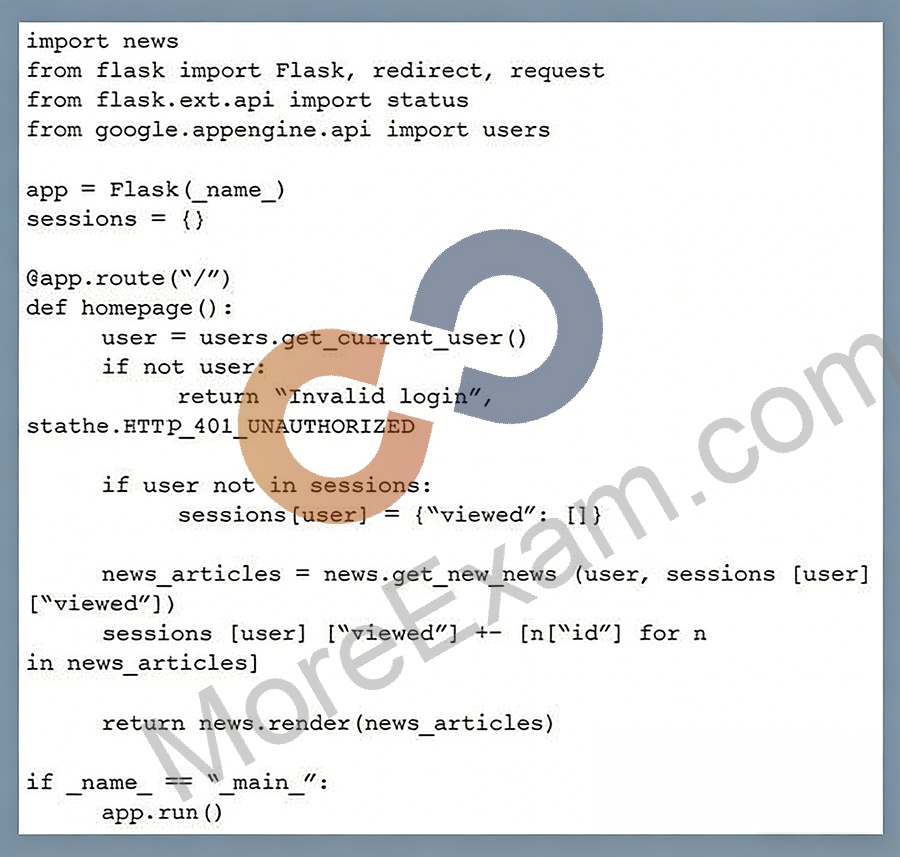
Question129: A news feed web service has the following code running on Google App Engine. During peak load, users report that they can see news articles they already viewed.What is the most likely cause of this problem?
Question130: Your company is building a new architecture to support its data-centric business focus. You are responsible for setting up the network. Your company's mobile and web-facing applications will be deployed on-premises, and all data analysis will be conducted in GCP. The plan is to process and load 7 years of archived .csv files totaling 900 TB of data and then continue loading 10 TB of data daily. You currently have an existing 100-MB internet connection.What actions will meet your company's needs?
Question131: You need to migrate Hadoop jobs for your company's Data Science team without modifying the underlying infrastructure. You want to minimize costs and infrastructure management effort. What should you do?
Question132: You want to automate the creation of a managed instance group and a startup script to install the OS package dependencies. You want to minimize the startup time for VMs in the instance group.What should you do?
Question133: Your customer wants to capture multiple GBs of aggregate real-time key performance indicators (KPIs) from their game servers running on Google Cloud Platform and monitor the KPIs with low latency. How should they capture the KPIs?
Question134: Case Study: 4 - Dress4Win case studyCompany OverviewDress4win is a web-based company that helps their users organize and manage their personal wardrobe using a website and mobile application. The company also cultivates an active social network that connects their users with designers and retailers. They monetize their services through advertising, e-commerce, referrals, and a freemium app model.Company BackgroundDress4win's application has grown from a few servers in the founder's garage to several hundred servers and appliances in a colocated data center. However, the capacity of their infrastructure is now insufficient for the application's rapid growth. Because of this growth and the company's desire to innovate faster, Dress4win is committing to a full migration to a public cloud.Solution ConceptFor the first phase of their migration to the cloud, Dress4win is considering moving their development and test environments. They are also considering building a disaster recovery site, because their current infrastructure is at a single location. They are not sure which components of their architecture they can migrate as is and which components they need to change before migrating them.Existing Technical EnvironmentThe Dress4win application is served out of a single data center location.Databases:MySQL - user data, inventory, static dataRedis - metadata, social graph, cachingApplication servers:Tomcat - Java micro-servicesNginx - static contentApache Beam - Batch processingStorage appliances:iSCSI for VM hostsFiber channel SAN - MySQL databasesNAS - image storage, logs, backupsApache Hadoop/Spark servers:Data analysisReal-time trending calculationsMQ servers:MessagingSocial notificationsEventsMiscellaneous servers:Jenkins, monitoring, bastion hosts, security scannersBusiness RequirementsBuild a reliable and reproducible environment with scaled parity of production. Improve security by defining and adhering to a set of security and Identity and Access Management (IAM) best practices for cloud.Improve business agility and speed of innovation through rapid provisioning of new resources.Analyze and optimize architecture for performance in the cloud. Migrate fully to the cloud if all other requirements are met.Technical RequirementsEvaluate and choose an automation framework for provisioning resources in cloud. Support failover of the production environment to cloud during an emergency. Identify production services that can migrate to cloud to save capacity.Use managed services whenever possible.Encrypt data on the wire and at rest.Support multiple VPN connections between the production data center and cloud environment.CEO StatementOur investors are concerned about our ability to scale and contain costs with our current infrastructure. They are also concerned that a new competitor could use a public cloud platform to offset their up-front investment and freeing them to focus on developing better features.CTO StatementWe have invested heavily in the current infrastructure, but much of the equipment is approaching the end of its useful life. We are consistently waiting weeks for new gear to be racked before we can start new projects. Our traffic patterns are highest in the mornings and weekend evenings; during other times, 80% of our capacity is sitting idle.CFO StatementOur capital expenditure is now exceeding our quarterly projections. Migrating to the cloud will likely cause an initial increase in spending, but we expect to fully transition before our next hardware refresh cycle. Our total cost of ownership (TCO) analysis over the next 5 years puts a cloud strategy between 30 to 50% lower than our current model.For this question, refer to the Dress4Win case study.Dress4Win has asked you to recommend machine types they should deploy their application servers to. How should you proceed?
Question135: For this question refer to the TerramEarth case studyOperational parameters such as oil pressure are adjustable on each of TerramEarth's vehicles to increase their efficiency, depending on their environmental conditions. Your primary goal is to increase the operating efficiency of all 20 million cellular and unconnected vehicles in the field How can you accomplish this goal?
Question136: You need to develop procedures to verify resilience of disaster recovery for remote recovery using GCP. Your production environment is hosted on-premises. You need to establish a secure, redundant connection between your on premises network and the GCP network.What should you do?
Question137: Your customer is receiving reports that their recently updated Google App Engine application is taking approximately 30 seconds to load for some of their users. This behavior was not reported before the update. What strategy should you take?
Question138: Your solution is producing performance bugs in production that you did not see in staging and test environments. You want to adjust your test and deployment procedures to avoid this problem in the future.What should you do?
Question139: Case Study: 7 - Mountkirk GamesCompany OverviewMountkirk Games makes online, session-based, multiplayer games for mobile platforms. They build all of their games using some server-side integration. Historically, they have used cloud providers to lease physical servers.Due to the unexpected popularity of some of their games, they have had problems scaling their global audience, application servers, MySQL databases, and analytics tools.Their current model is to write game statistics to files and send them through an ETL tool that loads them into a centralized MySQL database for reporting.Solution ConceptMountkirk Games is building a new game, which they expect to be very popular. They plan to deploy the game's backend on Google Compute Engine so they can capture streaming metrics, run intensive analytics, and take advantage of its autoscaling server environment and integrate with a managed NoSQL database.Business RequirementsIncrease to a global footprint.Improve uptime - downtime is loss of players.Increase efficiency of the cloud resources we use.Reduce latency to all customers.Technical RequirementsRequirements for Game Backend PlatformDynamically scale up or down based on game activity.Connect to a transactional database service to manage user profiles and game state.Store game activity in a timeseries database service for future analysis.As the system scales, ensure that data is not lost due to processing backlogs.Run hardened Linux distro.Requirements for Game Analytics PlatformDynamically scale up or down based on game activityProcess incoming data on the fly directly from the game serversProcess data that arrives late because of slow mobile networksAllow queries to access at least 10 TB of historical dataProcess files that are regularly uploaded by users' mobile devicesExecutive StatementOur last successful game did not scale well with our previous cloud provider, resulting in lower user adoption and affecting the game's reputation. Our investors want more key performance indicators (KPIs) to evaluate the speed and stability of the game, as well as other metrics that provide deeper insight into usage patterns so we can adapt the game to target users.Additionally, our current technology stack cannot provide the scale we need, so we want to replace MySQL and move to an environment that provides autoscaling, low latency load balancing, and frees us up from managing physical servers.For this question, refer to the Mountkirk Games case study. Mountkirk Games wants to design their solution for the future in order to take advantage of cloud and technology improvements as they become available. Which two steps should they take? (Choose two.)
Question140: A production database virtual machine on Google Compute Engine has an ext4-formatted persistent disk for data files The database is about to run out of storage space How can you remediate the problem with the least amount of downtime?
Question141: You have created several preemptible Linux virtual machine instances using Google Compute Engine. You want to properly shut down your application before the virtual machines are preempted. What should you do?
Question142: Your customer runs a web service used by e-commerce sites to offer product recommendations to users.the company has begun experimenting with a machine learning model on Google Cloud Platform toimprove the quality of results.What should the customer do to improve their model's results over time?
Question143: For this question, refer to the Helicopter Racing League (HRL) case study. The HRL development team releases a new version of their predictive capability application every Tuesday evening at 3 a.m. UTC to a repository. The security team at HRL has developed an in-house penetration test Cloud Function called Airwolf.The security team wants to run Airwolf against the predictive capability application as soon as it is released every Tuesday. You need to set up Airwolf to run at the recurring weekly cadence. What should you do?
Question144: For this question, refer to the Dress4Win case study.The Dress4Win security team has disabled external SSH access into production virtual machines (VMs) on Google Cloud Platform (GCP). The operations team needs to remotely manage the VMs, build and push Docker containers, and manage Google Cloud Storage objects. What can they do?
Question145: Case Study: 4 - Dress4Win case studyCompany OverviewDress4win is a web-based company that helps their users organize and manage their personal wardrobe using a website and mobile application. The company also cultivates an active social network that connects their users with designers and retailers. They monetize their services through advertising, e-commerce, referrals, and a freemium app model.Company BackgroundDress4win's application has grown from a few servers in the founder's garage to several hundred servers and appliances in a colocated data center. However, the capacity of their infrastructure is now insufficient for the application's rapid growth. Because of this growth and the company's desire to innovate faster, Dress4win is committing to a full migration to a public cloud.Solution ConceptFor the first phase of their migration to the cloud, Dress4win is considering moving their development and test environments. They are also considering building a disaster recovery site, because their current infrastructure is at a single location. They are not sure which components of their architecture they can migrate as is and which components they need to change before migrating them.Existing Technical EnvironmentThe Dress4win application is served out of a single data center location.Databases:MySQL - user data, inventory, static data* Redis - metadata, social graph, caching* Application servers:Tomcat - Java micro-services* Nginx - static content* Apache Beam - Batch processing* Storage appliances:iSCSI for VM hosts* Fiber channel SAN - MySQL databases* NAS - image storage, logs, backups* Apache Hadoop/Spark servers:Data analysis* Real-time trending calculations* MQ servers:Messaging* Social notifications* Events* Miscellaneous servers:Jenkins, monitoring, bastion hosts, security scanners* Business Requirements* Build a reliable and reproducible environment with scaled parity of production. Improve security by defining and adhering to a set of security and Identity and Access Management (IAM) best practices for cloud.Improve business agility and speed of innovation through rapid provisioning of new resources.Analyze and optimize architecture for performance in the cloud. Migrate fully to the cloud if all other requirements are met.Technical RequirementsEvaluate and choose an automation framework for provisioning resources in cloud. Support failover of the production environment to cloud during an emergency. Identify production services that can migrate to cloud to save capacity.Use managed services whenever possible.Encrypt data on the wire and at rest.Support multiple VPN connections between the production data center and cloud environment.CEO StatementOur investors are concerned about our ability to scale and contain costs with our current infrastructure. They are also concerned that a new competitor could use a public cloud platform to offset their up-front investment and freeing them to focus on developing better features.CTO StatementWe have invested heavily in the current infrastructure, but much of the equipment is approaching the end of its useful life. We are consistently waiting weeks for new gear to be racked before we can start new projects. Our traffic patterns are highest in the mornings and weekend evenings; during other times, 80% of our capacity is sitting idle.CFO StatementOur capital expenditure is now exceeding our quarterly projections. Migrating to the cloud will likely cause an initial increase in spending, but we expect to fully transition before our next hardware refresh cycle. Our total cost of ownership (TCO) analysis over the next 5 years puts a cloud strategy between 30 to 50% lower than our current model.For this question, refer to the Dress4Win case study.Dress4Win would like to become familiar with deploying applications to the cloud by successfully deploying some applications quickly, as is. They have asked for your recommendation. What should you advise?
Question146: The current Dress4Win system architecture has high latency to some customers because it is located in one data center.As of a future evaluation and optimizing for performance in the cloud, Dresss4Win wants to distribute its system architecture to multiple locations when Google cloud platform.Which approach should they use?
Question147: You are using Cloud CDN to deliver static HTTP(S) website content hosted on a Compute Engine instancegroup. You want to improve the cache hit ratio.What should you do?
Question148: You want to create a private connection between your instances on Compute Engine and your on- premises data center. You require a connection of at least 20 Gbps. You want to follow Google- recommended practices. How should you set up the connection?
Question149: Mountkirk Games needs to create a repeatable and configurable mechanism for deploying isolated application environments. Developers and testers can access each other's environments and resources, but they cannot access staging or production resources. The staging environment needs access to some services from production.What should you do to isolate development environments from staging and production?
Question150: You have a Python web application with many dependencies that requires 0.1 CPU cores and 128 MB of memory to operate in production. You want to monitor and maximize machine utilization. You also to reliably deploy new versions of the application. Which set of steps should you take?
Question151: Case Study: 2 - TerramEarth Case StudyCompany OverviewTerramEarth manufactures heavy equipment for the mining and agricultural industries: About80% of their business is from mining and 20% from agriculture. They currently have over 500 dealers and service centers in 100 countries. Their mission is to build products that make their customers more productive.Company BackgroundTerramEarth formed in 1946, when several small, family owned companies combined to retool after World War II. The company cares about their employees and customers and considers them to be extended members of their family.TerramEarth is proud of their ability to innovate on their core products and find new markets as their customers' needs change. For the past 20 years trends in the industry have been largely toward increasing productivity by using larger vehicles with a human operator.Solution ConceptThere are 20 million TerramEarth vehicles in operation that collect 120 fields of data per second.Data is stored locally on the vehicle and can be accessed for analysis when a vehicle is serviced.The data is downloaded via a maintenance port. This same port can be used to adjust operational parameters, allowing the vehicles to be upgraded in the field with new computing modules.Approximately 200,000 vehicles are connected to a cellular network, allowing TerramEarth to collect data directly. At a rate of 120 fields of data per second, with 22 hours of operation per day.TerramEarth collects a total of about 9 TB/day from these connected vehicles.Existing Technical EnvironmentTerramEarth's existing architecture is composed of Linux-based systems that reside in a data center. These systems gzip CSV files from the field and upload via FTP, transform and aggregate them, and place the data in their data warehouse. Because this process takes time, aggregated reports are based on data that is 3 weeks old.With this data, TerramEarth has been able to preemptively stock replacement parts and reduce unplanned downtime of their vehicles by 60%. However, because the data is stale, some customers are without their vehicles for up to 4 weeks while they wait for replacement parts.Business Requirements- Decrease unplanned vehicle downtime to less than 1 week, withoutincreasing the cost of carrying surplus inventory- Support the dealer network with more data on how their customers usetheir equipment IP better position new products and services.- Have the ability to partner with different companies-especially withseed and fertilizer suppliers in the fast-growing agriculturalbusiness-to create compelling joint offerings for their customersCEO StatementWe have been successful in capitalizing on the trend toward larger vehicles to increase the productivity of our customers. Technological change is occurring rapidly and TerramEarth has taken advantage of connected devices technology to provide our customers with better services, such as our intelligent farming equipment. With this technology, we have been able to increase farmers' yields by 25%, by using past trends to adjust how our vehicles operate. These advances have led to the rapid growth of our agricultural product line, which we expect will generate 50% of our revenues by 2020.CTO StatementOur competitive advantage has always been in the manufacturing process with our ability to build better vehicles for tower cost than our competitors. However, new products with different approaches are constantly being developed, and I'm concerned that we lack the skills to undergo the next wave of transformations in our industry. Unfortunately, our CEO doesn't take technology obsolescence seriously and he considers the many new companies in our industry to be niche players. My goals are to build our skills while addressing immediate market needs through incremental innovations.For this question, refer to the TerramEarth case study. TerramEarth's CTO wants to use the raw data from connected vehicles to help identify approximately when a vehicle in the field will have a catastrophic failure. You want to allow analysts to centrally query the vehicle data. Which architecture should you recommend?
Question152: You write a Python script to connect to Google BigQuery from a Google Compute Engine virtual machine. The script is printing errors that it cannot connect to BigQuery. What should you do to fix the script?
Question153: Your organization has a 3-tier web application deployed in the same network on Google Cloud Platform.Each tier (web, API, and database) scales independently of the others Network traffic should flow through the web to the API tier and then on to the database tier. Traffic should not flow between the web and the database tier. How should you configure the network?
Question154: Your company runs several databases on a single MySQL instance. They need to take backups of a specific database at regular intervals. The backup activity needs to complete as quickly as possible and cannot be allowed to impact disk performance. How should you configure the storage?
Question155: For this question, refer to the Dress4Win case study. To be legally compliant during an audit, Dress4Win must be able to give insights in all administrative actions that modify the configuration or metadata of resources on Google Cloud.What should you do?
Question156: You deploy your custom Java application to Google App Engine. It fails to deploy and gives you the following stack trace.What should you do?
Question157: Your customer is moving an existing corporate application to Google Cloud Platform from an on- premises data center. The business owners require minimal user disruption. There are strict security team requirements for storing passwords.What authentication strategy should they use?
Question158: Your company is moving 75 TB of data into Google Cloud. You want to use Cloud Storage and follow Google- recommended practices. What should you do?
Question159: Case Study: 4 - Dress4Win case studyCompany OverviewDress4win is a web-based company that helps their users organize and manage their personal wardrobe using a website and mobile application. The company also cultivates an active social network that connects their users with designers and retailers. They monetize their services through advertising, e-commerce, referrals, and a freemium app model.Company BackgroundDress4win's application has grown from a few servers in the founder's garage to several hundred servers and appliances in a colocated data center. However, the capacity of their infrastructure is now insufficient for the application's rapid growth. Because of this growth and the company's desire to innovate faster, Dress4win is committing to a full migration to a public cloud.Solution ConceptFor the first phase of their migration to the cloud, Dress4win is considering moving their development and test environments. They are also considering building a disaster recovery site, because their current infrastructure is at a single location. They are not sure which components of their architecture they can migrate as is and which components they need to change before migrating them.Existing Technical EnvironmentThe Dress4win application is served out of a single data center location.Databases:MySQL - user data, inventory, static data* Redis - metadata, social graph, caching* Application servers:Tomcat - Java micro-services* Nginx - static content* Apache Beam - Batch processing* Storage appliances:iSCSI for VM hosts* Fiber channel SAN - MySQL databases* NAS - image storage, logs, backups* Apache Hadoop/Spark servers:Data analysis* Real-time trending calculations* MQ servers:Messaging* Social notifications* Events* Miscellaneous servers:Jenkins, monitoring, bastion hosts, security scanners* Business Requirements* Build a reliable and reproducible environment with scaled parity of production. Improve security by defining and adhering to a set of security and Identity and Access Management (IAM) best practices for cloud.Improve business agility and speed of innovation through rapid provisioning of new resources.Analyze and optimize architecture for performance in the cloud. Migrate fully to the cloud if all other requirements are met.Technical RequirementsEvaluate and choose an automation framework for provisioning resources in cloud. Support failover of the production environment to cloud during an emergency. Identify production services that can migrate to cloud to save capacity.Use managed services whenever possible.Encrypt data on the wire and at rest.Support multiple VPN connections between the production data center and cloud environment.CEO StatementOur investors are concerned about our ability to scale and contain costs with our current infrastructure. They are also concerned that a new competitor could use a public cloud platform to offset their up-front investment and freeing them to focus on developing better features.CTO StatementWe have invested heavily in the current infrastructure, but much of the equipment is approaching the end of its useful life. We are consistently waiting weeks for new gear to be racked before we can start new projects. Our traffic patterns are highest in the mornings and weekend evenings; during other times, 80% of our capacity is sitting idle.CFO StatementOur capital expenditure is now exceeding our quarterly projections. Migrating to the cloud will likely cause an initial increase in spending, but we expect to fully transition before our next hardware refresh cycle. Our total cost of ownership (TCO) analysis over the next 5 years puts a cloud strategy between 30 to 50% lower than our current model.For this question, refer to the Dress4Win case study.Dress4Win would like to become familiar with deploying applications to the cloud by successfully deploying some applications quickly, as is. They have asked for your recommendation. What should you advise?
Question160: For this question, refer to the Helicopter Racing League (HRL) case study. HRL wants better prediction accuracy from their ML prediction models. They want you to use Google's AI Platform so HRL can understand and interpret the predictions. What should you do?
Question161: You want to enable your running Google Container Engine cluster to scale as demand for your application changes.What should you do?
Question162: Your development team has created a structured API to retrieve vehicle data. They want to allow third parties to develop tools for dealerships that use this vehicle event data. You want to support delegated authorization against this data.What should you do?
Question163: For this question, refer to the TerramEarth case study. You are asked to design a new architecture for the ingestion of the data of the 200,000 vehicles that are connected to a cellular network. You want to follow Google-recommended practices.Considering the technical requirements, which components should you use for the ingestion of the data?
Question164: For this question, refer to the JencoMart case study.JencoMart wants to move their User Profiles database to Google Cloud Platform. Which Google Database should they use?
Question165: Your organization has a 3-tier web application deployed in the same network on Google Cloud Platform.Each tier (web, API, and database) scales independently of the others. Network traffic should flow through the web to the API tier and then on to the database tier. Traffic should not flow between the web and the database tier.How should you configure the network?
Question166: Your company places a high value on being responsive and meeting customer needs quickly. Their primary business objectives are release speed and agility. You want to reduce the chance of security errors being accidentally introduced. Which two actions can you take? Choose 2 answers
Question167: One of your primary business objectives is being able to trust the data stored in your application. You want to log all changes to the application dat a. How can you design your logging system to verify authenticity of your logs?
Question168: You need to evaluate your team readiness for a new GCP project. You must perform the evaluation and create a skills gap plan incorporates the business goal of cost optimization. Your team has deployed two GCP projects successfully to date. What should you do?
Question169: You need to evaluate your team readiness for a new GCP project. You must perform the evaluation and create a skills gap plan which incorporates the business goal of cost optimization. Your team has deployed two GCP projects successfully to date. What should you do?
Question170: Your customer wants to capture multiple GBs of aggregate real-time key performance indicators (KPIs) from their game servers running on Google Cloud Platform and monitor the KPIs with low latency. How should they capture the KPIs?
Question171: You are migrating your on-premises solution to Google Cloud in several phases. You will use Cloud VPNto maintain a connection between your on-premises systems and Google Cloud until the migration iscompleted. You want to make sure all your on-premises systems remain reachable during this period. Howshould you organize your networking in Google Cloud?
Question172: Your company has successfully migrated to the cloud and wants to analyze their data stream to optimize operations. They do not have any existing code for this analysis, so they are exploring all their options. These options include a mix of batch and stream processing, as they are running some hourly jobs and live-processing some data as it comes in. Which technology should they use for this?
Question173: Auditors visit your teams every 12 months and ask to review all the Google Cloud Identity and Access Management (Cloud IAM) policy changes in the previous 12 months. You want to streamline and expedite the analysis and audit process. What should you do?
Question174: The application reliability team at your company has added a debug feature to their backend service to send all server events to Google Cloud Storage for eventual analysis. The event records are at least 50 KB and at most15 MB and are expected to peak at 3,000 events per second. You want to minimize data loss.Which process should you implement?
Question175: You have been engaged by your client to lead the migration of their application infrastructure to GCP. One of their current problems is that the on-premises high performance SAN is requiring frequent and expensive upgrades to keep up with the variety of workloads that are identified as follows: 20TB of log archives retained for legal reasons; 500 GB of VM boot/data volumes and templates; 500 GB of image thumbnails; 200 GB of customer session state data that allows customers to restart sessions even if off- line for several days.Which of the following best reflects your recommendations for a cost-effective storage allocation?
Question176: An application development team believes their current logging tool will not meet their needs for their new cloud-based product. They want a bettor tool to capture errors and help them analyze their historical log data. You want to help them find a solution that meets their needs, what should you do?
Question177: For this question, refer to the Dress4Win case study.As part of Dress4Win's plans to migrate to the cloud, they want to be able to set up a managed logging and monitoring system so they can handle spikes in their traffic load.They want to ensure that:* The infrastructure can be notified when it needs to scale up and down to handle the ebb and flow of usage throughout the day* Their administrators are notified automatically when their application reports errors.* They can filter their aggregated logs down in order to debug one piece of the application across many hosts Which Google StackDriver features should they use?
Question178: An application development team believes their current logging tool will not meet their needs for their new cloud-based product. They want a bettor tool to capture errors and help them analyze their historical log dat a. You want to help them find a solution that meets their needs, what should you do?
Question179: For this question, refer to the Dress4Win case study.You want to ensure Dress4Win's sales and tax records remain available for infrequent viewing by auditors for at least 10 years. Cost optimization is your top priority. Which cloud services should you choose?
Question180: A news teed web service has the following code running on Google App Engine. During peak load, users report that they can see news articles they already viewed. What is the most likely cause of this problem?
Question181: Your company recently acquired a company that has infrastructure in Google Cloud. Each company has its own Google Cloud organization Each company is using a Shared Virtual Private Cloud (VPC) to provide network connectivity tor its applications Some of the subnets used by both companies overlap In order for both businesses to integrate, the applications need to have private network connectivity. These applications are not on overlapping subnets. You want to provide connectivity with minimal re-engineering. What should you do?
Question182: You are creating a solution to remove backup files older than 90 days from your backup Cloud Storage bucket. You want to optimize ongoing Cloud Storage spend. What should you do?
Question183: For this question, refer to the TerramEarth case study.The TerramEarth development team wants to create an API to meet the company's business requirements. You want the development team to focus their development effort on business value versus creating a custom framework. Which method should they use?
Question184: Your company wants to track whether someone is present in a meeting room reserved for a scheduled meeting. There are 1000 meeting rooms across 5 offices on 3 continents. Each room is equipped with a motion sensor that reports its status every second. The data from the motion detector includes only a sensor ID and several different discrete items of information. Analysts will use this data, together with information about account owners and office locations. Which database type should you use?
Question185: You are moving an application that uses MySQL from on-premises to Google Cloud. The application will run on Compute Engine and will use Cloud SQL. You want to cut over to the Compute Engine deployment of the application with minimal downtime and no data loss to your customers. You want to migrate the application with minimal modification. You also need to determine the cutover strategy. What should you do?
Question186: For this question, refer to the Helicopter Racing League (HRL) case study. HRL is looking for a cost-effective approach for storing their race data such as telemetry. They want to keep all historical records, train models using only the previous season's data, and plan for data growth in terms of volume and information collected.You need to propose a data solution. Considering HRL business requirements and the goals expressed by CEO S.Hawke, what should you do?
Question187: Your company wants to start using Google Cloud resources but wants to retain their on-premises Active Directory domain controller for identity management. What should you do?
Question188: For this question, refer to the JencoMart case study.JencoMart has built a version of their application on Google Cloud Platform that serves traffic to Asia. You want to measure success against their business and technical goals. Which metrics should you track?
Question189: You are running a cluster on Kubernetes Engine to serve a web application. Users are reporting that a specific part of the application is not responding anymore. You notice that all pods of your deployment keep restarting after 2 seconds. The application writes logs to standard output. You want to inspect the logs to find the cause of the issue. Which approach can you take?
Question190: A development manager is building a new application He asks you to review his requirements and identify what cloud technologies he can use to meet them.The application must:1. Be based on open-source technology for cloud portability2. Dynamically scale compute capacity based on demand3. Support continuous software delivery4. Run multiple segregated copies of the same application stack5. Deploy application bundles using dynamic templates6. Route network traffic to specific services based on URLWhich combination of technologies will meet all of his requirements?
Question191: Your company plans to migrate a multi-petabyte data set to the cloud. The data set must be available 24hrs a day. Your business analysts have experience only with using a SQL interface. How should you store the data to optimize it for ease of analysis?
Question192: For this question, refer to the TerramEarth case study.To speed up data retrieval, more vehicles will be upgraded to cellular connections and be able to transmit data to the ETL process. The current FTP process is error-prone and restarts the data transfer from the start of the file when connections fail, which happens often. You want to improve the reliability of the solution and minimize data transfer time on the cellular connections. What should you do?
Question193: Your company wants to try out the cloud with low risk. They want to archive approximately 100 TB of their log data to the cloud and test the analytics features available to them there, while also retaining that data as a long-term disaster recovery backup. Which two steps should they take? Choose 2 answers
Question194: For this question, refer to the Mountkirk Games case study. Which managed storage option meets Mountkirk's technical requirement for storing game activity in a time series database service?
Question195: For this question, refer to the Dress4Win case study.As part of Dress4Win's plans to migrate to the cloud, they want to be able to set up a managed logging and monitoring system so they can handle spikes in their traffic load. They want to ensure that:* The infrastructure can be notified when it needs to scale up and down to handle the ebb and flow of usage throughout the day* Their administrators are notified automatically when their application reports errors.* They can filter their aggregated logs down in order to debug one piece of the application across many hosts Which Google StackDriver features should they use?
Question196: Mountkirk Games wants to limit the physical location of resources to their operating Google Cloud regions.What should you do?
Question197: You need to evaluate your team readiness for a new GCP project. You must perform the evaluation and create a skills gap plan incorporates the business goal of cost optimization. Your team has deployed two GCP projects successfully to date. What should you do?
Question198: Your customer is receiving reports that their recently updated Google App Engine application is taking approximately 30 seconds to load for some of their users. This behavior was not reported before the update. What strategy should you take?
Question199: For this question, refer to the Dress4Win case study.At Dress4Win, an operations engineer wants to create a tow-cost solution to remotely archive copies of database backup files. The database files are compressed tar files stored in their current data center. How should he proceed?
Question200: Your organization has decided to restrict the use of external IP addresses on instances to only approved instances. You want to enforce this requirement across all of your Virtual Private Clouds (VPCs). What should you do?
Question201: For this question, refer to the TerramEarth case study. You are asked to design a new architecture for the ingestion of the data of the 200,000 vehicles that are connected to a cellular network. You want to follow Google-recommended practices.Considering the technical requirements, which components should you use for the ingestion of the data?
Question202: You want to optimize the performance of an accurate, real-time, weather-charting application. The data comes from 50,000 sensors sending 10 readings a second, in the format of a timestamp and sensor reading. Where should you store the data?
Question203: For this question, refer to the TerramEarth case study.TerramEarth's 20 million vehicles are scattered around the world. Based on the vehicle's location its telemetry data is stored in a Google Cloud Storage (GCS) regional bucket (US. Europe, or Asia). The CTO has asked you to run a report on the raw telemetry data to determine why vehicles are breaking down after 100 K miles. You want to run this job on all the dat a. What is the most cost-effective way to run this job?
Question204: A small number of API requests to your microservices-based application take a very long time. You know that each request to the API can traverse many services. You want to know which service takes the longest in those cases.What should you do?
Question205: For this question, refer to the TerramEarth case study.The TerramEarth development team wants to create an API to meet the company's business requirements. You want the development team to focus their development effort on business value versus creating a custom framework. Which method should they use?
Question206: For this question, refer to the TerramEarth case study.TerramEarth plans to connect all 20 million vehicles in the field to the cloud. This increases the volume to 20 million 600 byte records a second for 40 TB an hour. How should you design the data ingestion?
Question207: Your company wants to track whether someone is present in a meeting room reserved for a scheduled meeting.There are 1000 meeting rooms across 5 offices on 3 continents. Each room is equipped with a motion sensor that reports its status every second. The data from the motion detector includes only a sensor ID and several different discrete items of information. Analysts will use this data, together with information about account owners and office locations. Which database type should you use?
Question208: To speed up data retrieval, more vehicles will be upgraded to cellular connections and be able to transmit data to the ETL process. The current FTP process is error-prone and restarts the data transfer from the start of the file when connections fail, which happens often. You want to improve the reliability of the solution and minimize data transfer time on the cellular connections.What should you do?
Question209: For this question, refer to the TerramEarth case study.TerramEarth has equipped unconnected trucks with servers and sensors to collet telemetry dat a. Next year they want to use the data to train machine learning models. They want to store this data in the cloud while reducing costs. What should they do?
Question210: For this question, refer to the TerramEarth case study. You need to implement a reliable, scalable GCP solution for the data warehouse for your company, TerramEarth.Considering the TerramEarth business and technical requirements, what should you do?
Question211: A development team at your company has created a dockerized HTTPS web application. You need to deploy the application on Google Kubernetes Engine (GKE) and make sure that the application scales automatically.How should you deploy to GKE?
Question212: One of the developers on your team deployed their application in Google Container Engine with the Dockerfile below. They report that their application deployments are taking too long.You want to optimize this Dockerfile for faster deployment times without adversely affecting the app's functionality.Which two actions should you take? Choose 2 answers.
Question213: Your company is moving 75 TB of data into Google Cloud. You want to use Cloud Storage and follow Google- recommended practices. What should you do?
Question214: You have developed a non-critical update to your application that is running in a managed instance group, and have created a new instance template with the update that you want to release. To prevent any possible impact to the application, you don't want to update any running instances. You want any new instances that are created by the managed instance group to contain the new update. What should you do?
Question215: For this question, refer to the Mountkirk Games case study.Mountkirk Games wants to set up a continuous delivery pipeline. Their architecture includes many small services that they want to be able to update and roll back quickly.Mountkirk Games has the following requirements:* Services are deployed redundantly across multiple regions in the US and Europe.* Only frontend services are exposed on the public internet.* They can provide a single frontend IP for their fleet of services.* Deployment artifacts are immutable.Which set of products should they use?
Question216: You need to upload files from your on-premises environment to Cloud Storage. You want the files to be encrypted on Cloud Storage using customer-supplied encryption keys. What should you do?
Question217: For this question, refer to the JencoMart case study.JencoMart has built a version of their application on Google Cloud Platform that serves traffic to Asia. You want to measure success against their business and technical goals. Which metrics should you track?
Question218: You are implementing Firestore for Mountkirk Games. Mountkirk Games wants to give a new game programmatic access to a legacy game's Firestore database. Access should be as restricted as possible. What should you do?
Question219: For this question, refer to the Dress4Win case study.Dress4Win has asked you to recommend machine types they should deploy their application servers to. How should you proceed?
Question220: Dress4Win has configured a new uptime check with Google Stackdriver for several of their legacy services.The Stackdriver dashboard is not reporting the services as healthy.What should they do?
Question221: Your company's user-feedback portal comprises a standard LAMP stack replicated across two zones. It is deployed in the us-central1 region and uses autoscaled managed instance groups on all layers, except the database. Currently, only a small group of select customers have access to the portal. The portal meets a 99.99% availability SLA under these conditions However next quarter, your company will be making the portal available to all users, including unauthenticated users. You need to develop a resiliency testing strategy to ensure the system maintains the SLA once they introduce additional user load. What should you do?
Question222: You are deploying an application on App Engine that needs to integrate with an on-premises database. For security purposes, your on-premises database must not be accessible through the public Internet. What should you do?
Question223: Your customer is receiving reports that their recently updated Google App Engine application is taking approximately 30 seconds to load for some of their users. This behavior was not reported before the update.What strategy should you take?
Question224: For this question, refer to the TerramEarth case study.TerramEarth has equipped unconnected trucks with servers and sensors to collet telemetry data. Next year they want to use the data to train machine learning models. They want to store this data in the cloud while reducing costs. What should they do?
Question225: You write a Python script to connect to Google BigQuery from a Google Compute Engine virtual machine.The script is printing errors that it cannot connect to BigQuery.What should you do to fix the script?
Question226: A small number of API requests to your microservices-based application take a very long time. You know that each request to the API can traverse many services. You want to know which service takes the longest in those cases. What should you do?
Question227: You want to make a copy of a production Linux virtual machine in the US-Central region. You want to manage and replace the copy easily if there are changes on the production virtual machine. You will deploy the copy as a new instances in a different project in the US-East region. What steps must you take?